
 Spend the days leading up to Martin Luther King, Jr. Day, on January 19, with classroom resources focused on Dr. King and texts he wrote. The materials below, pulled from the ReadWriteThink site, range from mini-lessons to complete units and cross all grade levels.
So read on, and celebrate Dr. Martin Luther King, Jr. and his work with these activities:
- In 1929, Martin Luther King, Jr. was born on this day. (Grades K–12)
Students study Martin Luther King Jr.’s “I Have a Dream” speech and work in groups to create a mural that depicts Dr. King’s vision of peace. - Exploring the Power of Martin Luther King, Jr.’s Words through Diamante Poetry (Grades 9–12)
Students explore the ways that powerful and passionate words communicate the concepts of freedom, justice, discrimination, and the American Dream in Martin Luther King, Jr.’s “I Have a Dream” speech. - Entering History: Nikki Giovanni and Martin Luther King, Jr. (Grades 6–8)
Nikki Giovanni’s poem “The Funeral of Martin Luther King, Jr.” is paired with Dr. King’s “I Have a Dream” speech, taking students on a quest through time to the Civil Rights movement. - Dr. Martin Luther King, Jr. delivered his “I Have a Dream” speech in 1963. (Grades K–12)
Students explore the “I Have a Dream” Foundation’s website and brainstorm ways they can help themselves or others at their school achieve their educational dreams. - Martin Luther King, Jr. and Me: Identifying with a Hero (Grades K–2)
This lesson provides ideas for celebrating Martin Luther King, Jr. Day by encouraging students to explore the connections between Dr. King and themselves through journaling and inquiry-based research. - Living the Dream: 100 Acts of Kindness (Grades K–2)
This lesson provides the “action piece” for any study of Dr. Martin Luther King, Jr. In this project, students participate in Dr. King’s dream by doing 100 acts of kindness. - How Big Are Martin’s Big Words? Thinking Big about the Future (Grades 3–5)
Inspired by the book Martin’s Big Words, students explore information on Dr. King to think about his “big” words, then they write about their own “big” words and dreams. - Analyzing Famous Speeches as Arguments (Grades 9–12)
Students identify the rhetorical strategies in a famous speech and the specific purpose for each chosen device. - Every Punctuation Mark Matters: A Minilesson on Semicolons (Grades 6–8)
Students analyze stylistic choices and grammar use in authentic writing, focusing on the use of the semicolon in Martin Luther King Jr.’s “Letter from Birmingham Jail.” - I Have a Dream: Exploring Nonviolence in Young Adult Texts (Grades 9–12)
Students will identify how Martin Luther King Jr.’s dream of nonviolent conflict-resolution is reinterpreted in modern texts. Homework is differentiated to prompt discussion on how nonviolence is portrayed through characterization and conflict. Students will be formally assessed on a thesis essay that addresses the Six Kingian Principles of Nonviolence.
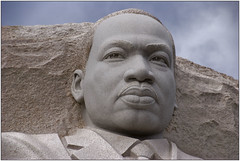
[Photo: Martin Luther King, Jr., Memorial — Washington (DC) December 2011 by Ron Cogswell, on Flickr]