

This post was written by NCTE member Deborah Dean.
My junior English class was about halfway through our reading of Cold Sassy Tree by Olive Ann Burns when a student question brought the discussion to a halt: “Why do so many people have the same first name in this town? Cudn Temp? Cudn Hope?”
 We had read much of the book aloud, so I thought that hearing the text might clarify the dialectical spelling for my students in Washington state, possibly unfamiliar with Southern dialect. Obviously, it hadn’t. And, without an understanding of the dialect, my student was totally missing an element of the book: the small town with multiple close relatives who would feel justified in having strong opinions on the living arrangements of an important family member. This was an important aspect relating to the tensions central to the book.
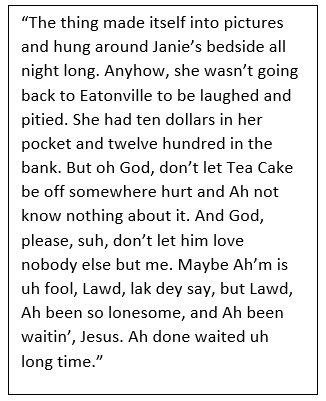
In Their Eyes Were Watching God, Zora Neale Hurston often uses dialect in meaningful ways that go beyond just hearing the characters’ voices. Hurston, herself, noted that the book was not accepted at first, because of the dialectical shifts: “The quieter voice of a woman searching for self-realization could not, or would not, be heard” (x). Sometimes, when the language shifts mid-paragraph, I pause to ask students why that might be, as in the passage on page 120, shown here in the first sidebar box.
For me, connecting grammar to reading means noticing when elements of language (such as dialect in Cold Sassy Tree and Their Eyes Were Watching God) impact the meaning of the text in significant ways. If language elements impact meaning, we should be prepared to teach them and help students see how meaning is enhanced through understanding a writer’s use of those language elements.
Beyond dialect, other considerations of language that could impact meaning in the texts we read in our classes might include the following: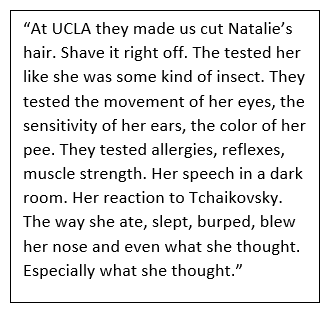
- Language change: We don’t use the word apothecary today, but in Romeo and Juliet, readers need to know what it means. It matters. When I consider what words students need to know to understand a literary text, I also consider words in the text that might not be used much—or at all—anymore. I don’t think these words need to be taught as vocabulary words with students quizzed on them. They are, after all, not words that will be expected in their expressive language. But if they are an example of language change and have an impact on understanding meaning, we should at least pause to explain and discuss.
- Syntax: Many writers use syntax to add depth of meaning to their texts. For example, when we are reading Al Capone Does My Shirts by Gennifer Choldenko, I ask students to consider several passages that use choppy syntax to consider why Choldenko would violate our expectations for sentences, as in the example shown in the second sidebar box. Students note the repetition of “tested” to reinforce the dehumanization Moose felt was part of the process. Students also see the lists without a final conjunction—and we talk about that choice. The choice has a name (asyndeton), which I may or may not share, but we talk about how they feel because of the lack of conjunction. They always say it seems to create a “piled-on” feeling—just what Moose would be feeling. The fragments suggest the broken nature of the process, at least from Moose’s perspective. In this way, students see that writers’ choices add depth and meaning to the words that readers read.
- Punctuation: Although it’s fairly sophisticated, helping students see Jonathan Swift’s use of semicolons can shed light on how writers show intent and tone, as the semicolon, used in different ways, suggests connections and separations of ideas that contribute to meaning (Dean 71-74).
To integrate language into reading in my classroom, I prepare as I do for teaching theme or character, or any literary element: I notice elements of language that contribute to meaning and that might impact students’ understanding of the book, poem, play, or story. As I do, I put those elements into my unit plans so that we can pause in our reading to consider these elements as part of our learning and understanding of the literature. I hope that doing so teaches students how to read more deeply and carefully—and I hope it also prepares them to use the same thoughtful approach in their independent reading. But I can encourage that in students, too, with other practices.
For example, sometimes I ask students to use sticky notes to identify passages in a text that they find particularly effective or moving or confusing. Often, those responses are a result of the use of language, and I can use students’ noticings to facilitate discussion. I want them to see that when they notice elements of a text, it’s often because the author is using language (grammar) to draw readers’ attention to something that matters in the text. They should pay attention to it.
When students are reading “My Name” in The House on Mango Street (Sandra Cisneros), they often post sticky notes on the first paragraph, noting the repetition of “It means” in the first four sentences. “I didn’t think we were supposed to repeat words,” they tell me. It’s a good time to ask them to consider why Cisneros would do something like that then. Eventually, they see that she is establishing a theme of this essay: who am I? In that context, what a name means, in both literal and figurative terms, helps establish the theme. Annie Dillard uses repetition of “wings” and “crawled” to create meaningful emphasis in a frequently anthologized excerpt from An American Childhood, as does Jacqueline Woodson in many places in Brown Girl Dreaming—aspects of the texts that students will be likely to notice.
Helping students see more deeply into the texts we study together (and the ones they read on their own) is an important outcome of most English classes. Modeling how language can play a part in that deeper understanding is something that we can do fairly smoothly in the context of our regular reading discussions. And that’s a very good thing for them as readers and language users.

Deborah Dean, formerly a secondary English teacher, is a professor of English at Brigham Young University, where she teaches preservice and practicing teachers about writing instruction. She is the author of What Works in Grammar Instruction; Strategic Writing: The Writing Process and Beyond in the Secondary English Classroom; Genre Theory: Teaching, Writing, and Being; What Works in Writing Instruction: Research and Practice; and the Quick-Reference Guide (QRG) Teaching Grammar in the Secondary Classroom.
It is the policy of NCTE in all publications, including the Literacy & NCTE blog, to provide a forum for the open discussion of ideas concerning the content and the teaching of English and the language arts. Publicity accorded to any particular point of view does not imply endorsement by the Executive Committee, the Board of Directors, the staff, or the membership at large, except in announcements of policy, where such endorsement is clearly specified.