Banned Books Week
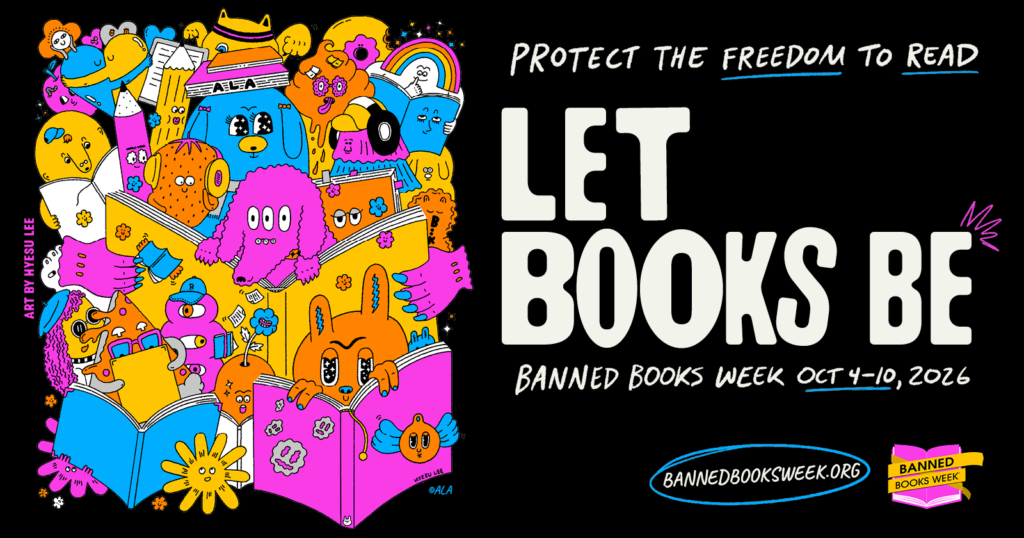
Read the 2026 Banned Books Week press release, the Honorary Chairs, and see the special artwork.
Banned Books Week has been shining a light on censorship since it was founded in 1982, and the fight for free expression is as urgent as ever.
NCTE is a cosponsor of the week and a long-time member of the Banned Books Week Coalition (BBWC). The BBWC is here to support the community of readers, including students, educators, librarians, and booksellers, in the United States and abroad.
Resources
- NCTE’s Intellectual Freedom Center
- The rationale database
- Report Censorship form
- BBWC programming materials and resources
- Visit bannedbooksweek.org or on social media to get the latest Banned Books Week and censorship news
- Top 11 Challenged Books of 2025
- Top 150 Most Frequently Challenged Books from ALA’s history of tracking bans
- Recent statement on H.R. 7661
- A Spotlight on School Book Bans, PEN America’s latest report
Events and actions
- NCTE has endorsed this year’s Banned Books Week resolution led by Representative Jamie Raskin and Senator Brian Schatz. Since 2022, NCTE has been named as a leader in these annual resolutions opposing book banning in schools and beyond.
- The Show Up, Speak Up Virtual Variety Show virtual event took place on Thursday, September 24 from 2:00 – 4:00 P.M. ET. NCTE and many other freedom to read advocates co-sponsored this event. Take action.
- Participate in the National Coalition Against Censorship’s Right to Read Night. The featured book for this year is Brown Girl Dreaming by Jacqueline Woodson. Download NCTE’s book rationale and this discussion guide from the NCTE Committee Against Censorship.
- Take action on Let Freedom Read Day, October 10th.
- Spotlight on Bess Kalb, Honorary Chair event, October 5, 2:00 p.m. ET.
- Spotlight on Tony Weaver, Jr., Honorary Chair event, October 6, 6:00 p.m. ET
- Drawing Better Maps: Navigating the Youth Librarianship Landscape in the Age of Book Challenges series of events on October 8. School librarianship focused event will take place at 4:00 p.m. ET.
- Whose Stories Belong? A Youth-Led Conversation on the Freedom to Read, Youth Honorary Chair event, October 8, 7:00 p.m. ET (registration available soon).
- Power Hour with Azeemah and Marshal, Youth Honorary Chair event, October 29, 7:00 p.m. ET (registration available soon).
- Check out the Banned Wagon Tour.
For decades, NCTE has worked with schools and educators on to stand up for intellectual freedom and provide anti-censorship resources. If you are facing a challenge, please consult the NCTE Intellectual Freedom Center to make a report, access resources, or contact NCTE.

Grounded in NCTE’s position statements The Students’ Right to Read and NCTE Beliefs about the Students’ Right to Write, this book focuses on high school English language arts classes, drawing from the work of seven teachers from across the country to illustrate how advocating for students’ rights to read and write can be revolutionary work.
Using diverse picturebooks, Angie Zapata offers practical approaches and guiding principles to explore literature through an anti-oppressive lens in the early childhood and elementary classroom. Drawing on NCTE’s position statement Preparing Teachers with Knowledge of Children’s and Young Adult Literature, this book will help you turn the teaching of reading of print and illustration into a transformative literacy encounter that nurtures readers and writers who understand the power of stories, especially their own, and who celebrate the diverse histories that shaped them.
 Beginning with the assertion that educators can effectively use comics and graphic novels to develop readers’ critical literacy and empathy, DeHart explores the use of graphic novels across grade levels in a wide range of topics and themes. Taking When Stars Are Scattered by Victoria Jamieson and Omar Mohamed as a recurring focal text, DeHart argues that critical conversations can be opened up through well-chosen graphic novels. The book features recommended titles, insights from graphic novel authors and creators, and lesson ideas.